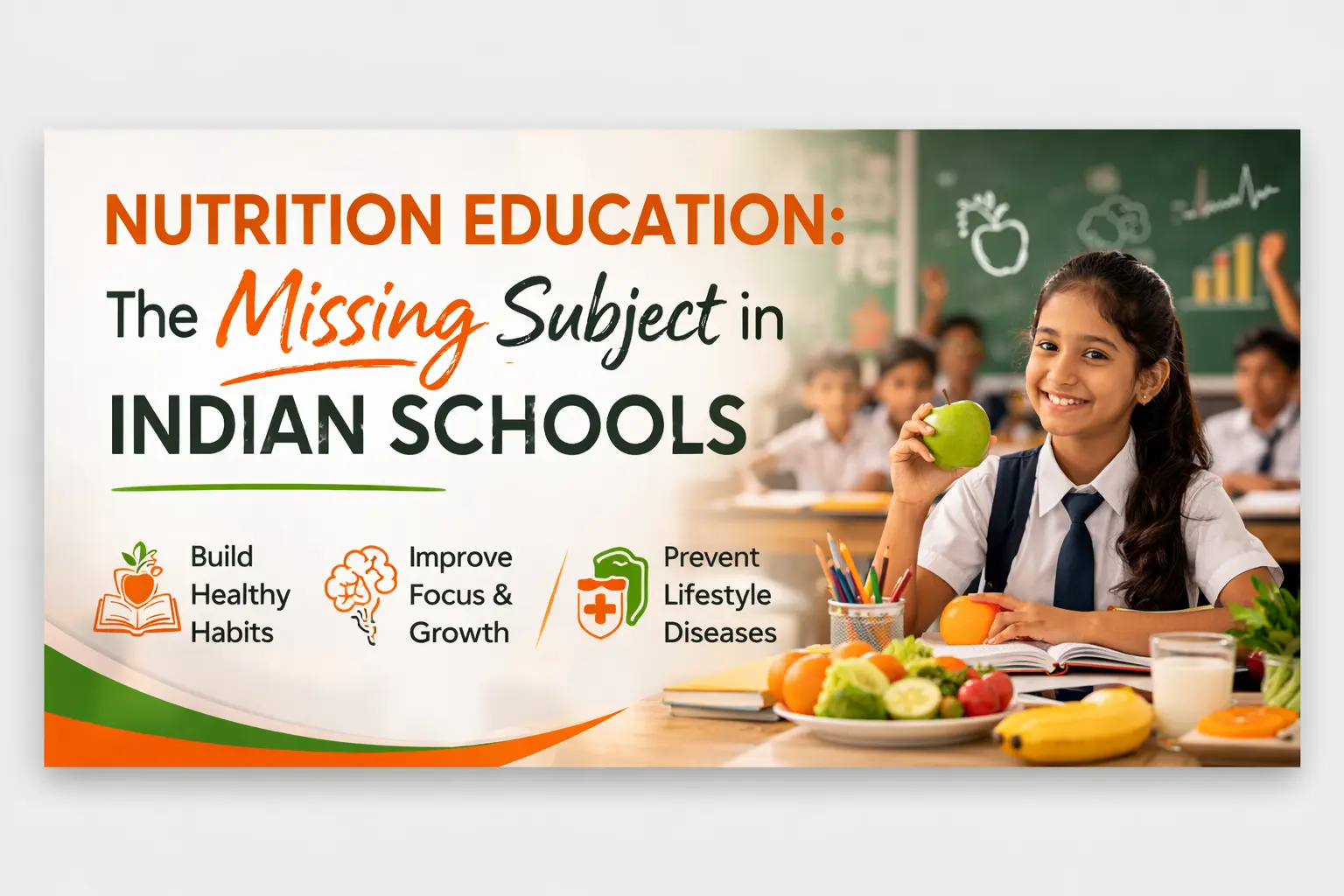
Nutrition Education: The Missing Subject in Indian Schools
March 11, 2026
There is a child I think about often. Bright, curious, top of her class in mathematics. Every morning her mother packs her a careful tiffin, roti, sabzi, a small fruit. But by recess, she has traded it for a packet of chips from the school canteen, because that is what her friends are eating. And nobody at school has ever told her why that might matter.
I do not share this to blame the child, or her mother, or even the school. The truth is, we have built an education system in India that prepares children remarkably well for exams, careers, and competition, but leaves a quiet, consequential gap when it comes to understanding their own bodies and the food that fuels them.
Nutrition education in Indian schools is not just absent. It is quietly, consistently overlooked. And the effects of that absence are playing out in real and visible ways.
We teach children to care for their futures through academics. It is time we also teach them to care for their bodies through food.
What Our Schools Teach and What They Don't
Indian schools work hard. Teachers put in long hours. Curricula are dense, and the pressure on both students and educators to perform academically is real. I say this not to criticise but to acknowledge the context we are working within.
And within that context, nutrition has always been an afterthought. If children encounter it at all, it is usually a few lines in a Class 5 or 6 science textbook, proteins for growth, carbohydrates for energy, vitamins for immunity. Definitions to memorise, not lessons to live by.
The importance of nutrition education for students goes far beyond being able to label food groups on a diagram. It is about understanding, at a practical level, why skipping breakfast makes you irritable by third period, or why a lunch of fried snacks leaves you sluggish rather than energised. That kind of knowledge does not come from a textbook paragraph. It comes from deliberate, thoughtful teaching and we are simply not doing it.
What Is Happening to Our Children's Health?
Spend an afternoon outside any school gate in India in Delhi, Bengaluru, Patna, Coimbatore, it does not much matter where and you will notice something similar. Children pouring out, reaching immediately for pani puri, vada pav, packaged noodles, or cola from the nearest vendor. This is not new. Street food has always been a part of Indian childhood.
What is new is the scale, the frequency, and the near-total absence of any awareness about what they are consuming. Many children today eat processed or fried foods not occasionally but daily, sometimes as their primary meal. Meanwhile, in many rural and semi-urban areas, a different problem persists, children who are undernourished, anaemic, or deficient in basic micronutrients, yet whose families have never received meaningful guidance on affordable, nutritious alternatives.
Both situations, excess in one place, deficiency in another, share the same underlying problem: a lack of nutrition awareness in India at the level where it matters most, which is childhood.
Poor eating habits formed at ten years old have a way of following a person into their forties. The window we have to shape those habits is shorter than most people realise.
The Connection Between Food and Learning That We Keep Missing
Here is something that should matter to every teacher and every parent: what a child eats directly affects how well they can think. This is not a wellness trend. It is physiology.
A child who eats a heavy, oily meal at lunch often struggles to concentrate in the afternoon sessions. A child who has skipped breakfast is likely to be distracted, short-tempered, or simply unable to retain information by mid-morning. We sometimes attribute these things to attitude or effort. Often, it is hunger or poor nutrition.
Teaching nutrition to students, then, is not a departure from academic priorities. In a very real sense, it supports them. A child who understands why food choices matter is a child who is better equipped to manage their own energy, mood, and focus and that has a direct bearing on how they learn.
What Early Nutrition Awareness Can Build
- Steadier energy and attention across the school day
- A reduced risk of nutritional deficiencies during key growth years
- The beginnings of independent, informed food choices
- Better physical health over time, with fewer preventable illnesses
- A foundation for healthy habits that tend to carry into adulthood
If Schools Taught Nutrition What Might Change?
It is worth imagining, for a moment, what healthy eating education for children could actually look like in practice. Not a lecture. Not more rote learning. But real, honest conversations about food.
A Class 7 student who knows why iron matters is more likely to eat her dal. A teenager who understands that blood sugar spikes from sugary drinks cause crashes not just in energy but in mood might think twice before that third Frooti. A young boy who has seen, even once, how a balanced meal is actually put together is more likely to have a reference point when making choices on his own.
Schools that have made even modest efforts in this direction a health week, a dietitian visit, a canteen that labels its food report something encouraging: children engage with this topic. They ask questions. They go home and tell their parents. They are not indifferent. They have simply never been given the information.
Children do not make poor food choices because they do not care. They make them because no one has ever shown them a better way, or explained why it matters.
Practical Steps Schools Can Actually Take
I want to be realistic here. Not every school has the resources for a dedicated nutrition teacher or a revamped canteen. But school health education in India does not have to be expensive or complicated to begin making a difference. It has to be intentional.
Weave It Into What Already Exists
Science classes are a natural home for practical nutrition conversations. Instead of only teaching the chemical composition of carbohydrates, a teacher can also ask: what does this mean for what you eat in the morning? Home Science classes, where they exist, can go well beyond recipes and into real meal planning for different age groups and health needs.
Use the Canteen as a Learning Tool
The school canteen is, whether we acknowledge it or not, already teaching children something about food every single day. Schools that guide what is sold, or that display simple nutritional information, are doing more than cafeteria management they are creating a living lesson. Even placing a "better choice" option next to the familiar one starts a quiet conversation.
Bring In People Who Do This Every Day
A nutritionist or a doctor speaking to students for even forty-five minutes can be more memorable than a month of textbook content. Real people, real stories, real consequences. Children respond to that kind of learning differently than to diagrams on a page.
Make It Hands-On Where Possible
Reading a food label. Planning a week's worth of meals on a small budget. Growing a small school garden. Visiting a local sabzi mandi with a purpose. These are experiences that connect nutrition to the actual texture of daily life, which is ultimately where all food choices are made.
Parents and Teachers: You Are Already Part of This
A parent once told me, with some exasperation, that her son would not eat vegetables at home but would eat them at school if they were served in the right way. It struck me then how much influence school environments quietly hold over children's habits often more than we give them credit for.
Teachers, too, carry more influence than they sometimes realise. An offhand comment from a teacher about what makes a good breakfast, or a moment of genuine curiosity about a student's tiffin, can plant a seed. It does not require a formal curriculum to begin.
And at home, parents who treat mealtimes as opportunities for conversation not interrogation, just gentle curiosity about food are doing something valuable. Children absorb attitudes, not just information. When the adults around them treat food as something worth understanding, children begin to as well.
The school-home connection is where lasting change actually happens. Neither can fully do this without the other.
The Larger Picture: What We Are Building Toward
India is already grappling with a rising burden of lifestyle diseases diabetes, hypertension, obesity that are increasingly affecting younger and younger people. These are not inevitable. Many of them are closely tied to the eating habits formed in childhood and adolescence, habits that, once set, are genuinely difficult to change.
If we begin taking nutrition education seriously at the school level today, we are not just improving children's lunches. We are changing the health trajectory of an entire generation. We are giving young people the tools to make better decisions for themselves, their future families, and their communities. That is a long return on a relatively modest investment.
A country that teaches its children to read, write, and calculate can surely also teach them to nourish themselves well. That knowledge will serve them every single day of their lives.
Where Do We Go From Here?
I do not think the answer here is complicated, even if the path is not always easy. For policymakers and curriculum designers, the ask is to take this seriously not as a supplementary activity but as a core life skill that belongs in every school, in every part of India.
For school leaders and teachers, the starting point can be small. A conversation. A health session once a month. A more thoughtful canteen menu. Small beginnings, consistently sustained, add up.
And for parents who are often the first and most lasting teachers their children will ever have the most meaningful thing is simply this: treat food as worth talking about. Not as a battleground, not with anxiety, but with genuine interest and care.
We have spent decades building children's minds. Their bodies deserve the same attention. Nutrition education may be the missing subject in Indian schools right now but it does not have to stay that way.